Tag Archives: learn

What are the most important Chinese characters?

Standard

[see the website based on the book –

https://www.hanzi-explorer.com/ ]

Buy from Amazon

This book, Chinese by Numbers, lists 7200 Chinese characters, but what are the most important characters?

I have chosen these 120 characters as the most common or important characters, reading down the columns from left to right. Of course, is the most important of all, as it modifies many word types to create adjectives, indicate possession and has many other uses. Click on the picture to visit my new website based on the book and search for characters in the most amazing ways (… once you get the hang of it.)
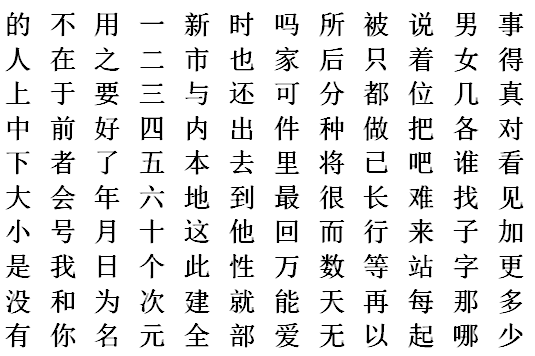
There are plenty more Chinese characters to learn, but these would be a head start. In Chinese by Numbers it is easy to see how important each character is just by the font-size. The larger the font-size the more important and vice-versa. Read more about this book on the other pages of this site.

de indicates possession; adjectival modifier; various grammatical uses
rén Humanity; adult man or woman; person with a specific occupation; character; state of health; manpower
shàng Up; high quality; preceding; former; upward; go up; go to; go ahead; appear on stage; serve (dishes); replenish; fix in place; apply; wind up; start work; in progress; on
zhōng Middle; China; amid; medium; evenhanded; go-between; suitable for; all right
xià Next; down; low; downward; under; time; descend; come down (e.g. rain); exit; put in; play (chess); unload; capture; yield; finish (work or study); used after a verb to indicate downward motion or completion
Large
xiǎo Small; of short duration; less than; younger; my
shì Yes; is; right; many grammatical uses
méi Have not; is not; did not; none; not as (in comparisons)
yǒu Have; exist; is; various related grammatic uses
Not; non; no; isn’t; can’t; or not
zài Exist; in, at, on etc.; remain; belong to; rely on; indicates something is in progress; add emphasis to a negative statement
In, on (a date); serves as a general preposition or verb suffix corresponding to ‘to’, ‘from’, ‘by’ and ‘than’
qián Front; straight ahead; ago; former; prior; future
zhě used as a suffix to indicate a person of a certain type or profession
huì Assemble; meet; society; main city; opportunity; understand; able to; excel at; likely to
hào Name; alias; firm; sign; number; size; type; numeric identifier; score
I; me; self
And; together; peace; harmony; gentle; a draw; of Japan
You; anyone
yòng Use; expense; need to; purpose
zhī Leave for; indicates possession; other various grammatical uses
hǎo Good; well; good health; friendly; OK; Hmm; easy; may; should; very; how much
le Indicates an action completed; various grammatical purposes
nián Year; annual; age; stage in life; times; New Year festival or associated things
yuè Moon; moon-shaped; month; monthly
Day; sun; a period of one day; daily; a particular day (e.g. birthday)
wéi Do; act as; become; be; various syntactic uses
wèi For; for the sake of; to; protect
míng Name; so-called; fame; well-known; measure word for people
One; a; same; also; whole; used with verbs or between repeated verbs to indicate short duration or a single action; various grammatical uses
èr Two; different
sān Three; several
Four
Five
liù Six
shí Ten; ultimate
A general measure word; individual
Order; rank; times; sub-standard; hypo-; measure word for occurrence
yuán First; principal; fundamental; unit
xīn New; make anew
shì City; market; buying and selling; municipality; unit (as in unit of weight etc.)
And; with; grant; be on good terms; commend; await
Take part in
nèi In; wife or wife’s relative; internal organ; imperial palace
běn This; root; basis; capital; chief; original; our; according to; book; edition; measure word for books, plants
de used as an adverbial modifier
Earth; geo-; land; field; place; position; situation; distance
zhè This
This; here and now; like this
jiàn Build; set up; advocate; Fujian province
quán All; complete; keep intact; wholly
shí Time; fixed time; season; present; fashion; chance; occasionally; tense (grammar)
Also; various related grammatical uses
hái Still; too; quite; even; or
chū Go out; come out; exceed; give; produce; publish; emit; become conspicuous; spend
Go; leave; lose; get rid of; pass away; modifying verbs to indicate timing or direction
dào Arrive; go to; indicating a completed action; thoughtful
He; something else; another
xìng Nature; property or quality; suffix indicating a quality; sexual; sex; gender (linguistics)
jiù At once; already; as soon as; then; as many as; just; only; come near; undertake; suffer; make; go with; concerning
Department; part; ministry; region
ma Question marker at the end of a sentence
jiā Home; family; a person in a certain trade; specialist; school of thought; domestic; a measure word for family or business
Indicates possibility; approve; can; yet; so; ever (in rhetorical questions); suit
jiàn Measure word for matters or clothes; item; document
Inside; in; lining; neighbourhood; native place; a unit of length of 500 metres; indicating a place in adverbs of place
zuì Most; best
huí Return; turn around; reply; circle; report back; measure word for occurrences; Muslim
wàn Ten thousand; large number; absolutely
néng Talent; energy; capable; can
ài Love; enjoy; care about; tend to
suǒ Place; office; measure word for buildings; various grammatical uses as an auxiliary
hòu After; back; last; offspring; empress
fēn Divide; assign; distinguish; branch; fraction; identifies the denominator; a single unit in many systems of measurement
fèn Component; natural limit; affection
zhǒng Species; race; seed; courage; measure word for type, sort or kind
jiāng Be going to do; support; take care of; breed; provoke; with (in idioms); and
hěn Very
ér And; (conjunction with various grammatical purposes)
shǔ Count; enumerate; reckon
shù Number; numeral; fate; a few; approximately
tiān Day; sky; Heaven; season; weather; innate; God
Nil; without; no; regardless of
bèi Indic. passive tense; quilt
zhī Single; measure word for animals, boats and certain paired things
zhǐ Only; just
dōu All; whole of; even; already
zuò Do; write; compose; engage in; become; be used as; agree to a relationship; pretend
Already; cease; thereafter
cháng Long; length; forte; surplus
xíng Go; walk; trip; travel; temporary; do; behaviour; OK; competent; shall; (of medicine) take effect
háng Row; profession; business; position in a family; measure word for lines of things
děng Wait; till; kind; grade; equal; and so on; indicating plural
zài Again; continue
With; by means of; according to; because of; so as to; at (a point in time); used in compounds to indicate relative time or place
shuō Say; explain; doctrine; scold; matchmake; indicate
zhe Verb suffix usually indicating continuation of action
zhāo A move in a chess game; trick; add; all right
zháo Touch; feel; burn; after a verb to indicate achievement; fall asleep
zhuó Wear (clothes); touch; apply; whereabouts; dispatch
wèi Position; location; throne; digit; measure word for people
Handle; hold; control; guard; near; bind. Measure word for objects with handles. Used before the object of a verb when it precedes the verb.
ba (Used at the end of a sentence to suggest; approve; doubt; presume)
nán Difficult; cause difficulties; not easy; displeasing
nàn Tragedy; take to task
lái Come; occur; do; future; past; various grammatical uses to modify verbs
zhàn Stand; stop; station; service centres
měi Each; every; often
Rise; remove; appear; initiate; draft; establish; get; indicates start point; measure word for instances; indicates upward direction; afford; links verb and object
nán Male; son
Woman
How many?; several
Small table; almost
Each; various; respectively
shéi Who; in rhetorical questions to indicate no one or anyone
zhǎo Look for; give change
Son; child; humans; ancient term of respect; philosophy; seed; egg; subsidiary; a small hard lump; a measure word for a small bundle held in the hand; first Earthly Branch
zi Noun suffix
Word; Chinese character; pronunciation; handwriting style; receipt; alias;
That; there; so
Which; where
shì Matter; trouble; job; responsibility; attend upon
Get; equals; complacent; be done; expressing anguish; used for special grammatical purposes
de after a verb indicates possibility
děi Need; have to; be sure to; cozy
zhēn True; really; distinctly; regular Chinese script; image; natural state
duì Correct; face; oppose; compare; opposite; treat; measure word for pair or couple; concerning
kàn Look; consider; call on; regard; treat (a patient); look after; caution!
jiàn See; meet with; appear to be; refer to; opinion
jiā Add; increase; append
gèng More; further
duō Many; much; in excess; more than; how much; emphasis applied to extent
shǎo Less; few; missing; owe; a moment

Available from:

http://www.amazon.com/Chinese-Numbers-ultimate-method-characters/dp/1922022241/a 

http://www.bookdepository.com/Chinese-by-Numbers-David-Pearce/9781922022240

http://www.barnesandnoble.com/w/chinese-by-numbers-david-j-pearce/1110603411?ean=9781922022240

Australian sales:

http://www.vividpublishing.com.au/chinesebynumbers/

UK sales:
http://www.amazon.co.uk/Chinese-Numbers-ultimate-method-characters/dp/1922022241/ref=sr_1_1?ie=UTF8&qid=1336792167&sr=8-1

Comparing Chinese by Numbers with Laurence Matthews’ Chinese Character Fast Finder

Standard

Buy from Amazon

[Visit the new website based on my book –http://www.hanzi-explorer.com/]

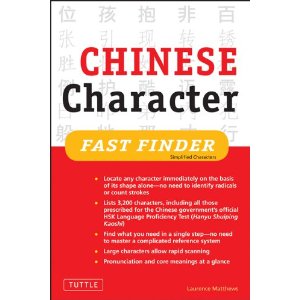
A few years ago I bought a copy of Laurence Matthews’ Chinese Character Fast Finder. I was pretty excited when I bought it. It was great to think that you could find characters without going through the tedious traditional method. I also found that this book had a feature that I had always wanted, which was a list of all the characters (3,200 in the book) in pinyin order. This is such a simple thing, but very useful. I also liked how characters that looked similar were grouped together. They were written with a big font and easy to see. That meant that it was easy to distinguish similar-looking characters that tended to be confused with each other.

After I had been using it for a while I realised that it is not as useful as I hoped for its primary purpose. The reasons are principally that it is indexed only on radicals and then grouped by “shape”. However, “shape” is a subjective term and I often would choose the wrong shape and then take even longer to find the character.

Another reason that it fails is that it contains just 3200 characters. That is a lot, but normally the characters I was wanting to identify were rarer characters. There were almost 5000 possible characters that were not listed.

However, I am thankful for having bought this book. It inspired me to find a better way to search for characters. I decided that a really useful book had to have as many characters as possible but present them in such a way that the reader easily recognised the most common characters from the least common characters. I decided to index every part of the character and I decided to permit searches on combinations of components. Where possible I also added the ability to search on the pinyin value of a component, where the component was also a character.

Chinese Character Fast Finder was the inspiration for this book, Chinese by Numbers, and I believe that my book better achieves the goals of Matthews’ book.

Available from:

http://www.amazon.com/Chinese-Numbers-ultimate-method-characters/dp/1922022241

http://www.bookdepository.com/Chinese-by-Numbers-David-Pearce/9781922022240

http://www.barnesandnoble.com/w/chinese-by-numbers-david-j-pearce/1110603411?ean=9781922022240

Australian sales:

http://www.vividpublishing.com.au/chinesebynumbers/

UK sales:
http://www.amazon.co.uk/Chinese-Numbers-ultimate-method-characters/dp/1922022241/ref=sr_1_1?ie=UTF8&qid=1336792167&sr=8-1

Misadventures with Chinese Dictionaries

Standard

Here are some reasons for using Chinese by Numbers instead of a typical Chinese dictionary.

To illustrate this case I will use the Oxford Concise Chinese-English Dictionary, which boasts around 4000 characters and which I have used for over ten years. It is a great small dictionary. I will also be using the Contemporary Chinese Dictionary which I bought in China. This is also excellent, has 2700 pages and a total of over 8000 characters, including several hundred that cannot be written with a standard computer, and hence are not in my book. Here are some examples that I might want to look for:

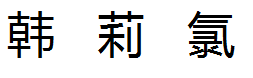
Case one. Let us start with . I see this character often in my newspaper and I want to find out its meaning, so I look it up in my Oxford. I start with the left side and look for the radical. Count strokes, eight. Search for radical. First problem is that the left-hand side is not a radical. Abandon that search. Return to search for the right-hand side. Count strokes, 4. Search for radical. Find radical. Search through radical index, but still I can’t find it! Why is this very common character not in my Concise Oxford? Repeat the process in my Contemporary Chinese Dictionary and find the character is located on page 763. (By now, several minutes of searching has elapsed.) I turn to page 763 and am confounded to find that the character refers to a state of the Zhou dynasty, a thousand years ago. But why is it so prominent in my newspaper? Turn to Chinese by Numbers: Look up any part of the character and quite quickly find entry 2036, which is “Korea.” Now I know my newspaper article is all about South Korea.

Case two. Suppose I come across this character, , searching through my Concise Oxford again does not find it. I will try the Contemporary Chinese Dictionary. The character has three possible radicals, so which is the radical to search on? Characters with 艹 cover three pages of my radical index! Characters with seven other strokes occupy two columns of that index. I don’t want to wade through that many, but it is not listed under 禾 or 刂. Turn to “Chinese by Numbers” and look up艹 in combination with either禾 or 刂, or禾 and 刂 separately or together. Find it quickly. Along the way find this fact – all characters containing 利 are pronounced lì, without exception. Remember that for future use.

Case three. I am looking for this character, , and again my Concise Oxford lets me down. It is not there. But this time I recognise the lower part of the character as lù. Because I have this knowledge, this time I go straight for “Chinese by Numbers.” In the pinyin index I find the component lù 录 and from there I can quickly find the Chinese character for Chlorine. I realise that having a good dictionary is vital, but finding characters quickly is better with a specialised book.

Read other pages on this site for more information,  or make an online purchase and see for yourself.

[NOTE: Chinese by Numbers is a ‘print on demand’ book. Each order is printed individually, especially for you, so the price is higher than other books sold from remainder stock.]

Available from Amazon and other online sites:

Buy from Amazon

Barnes and Noble

Australian sales

UK sales

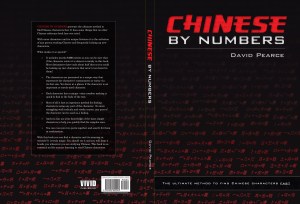
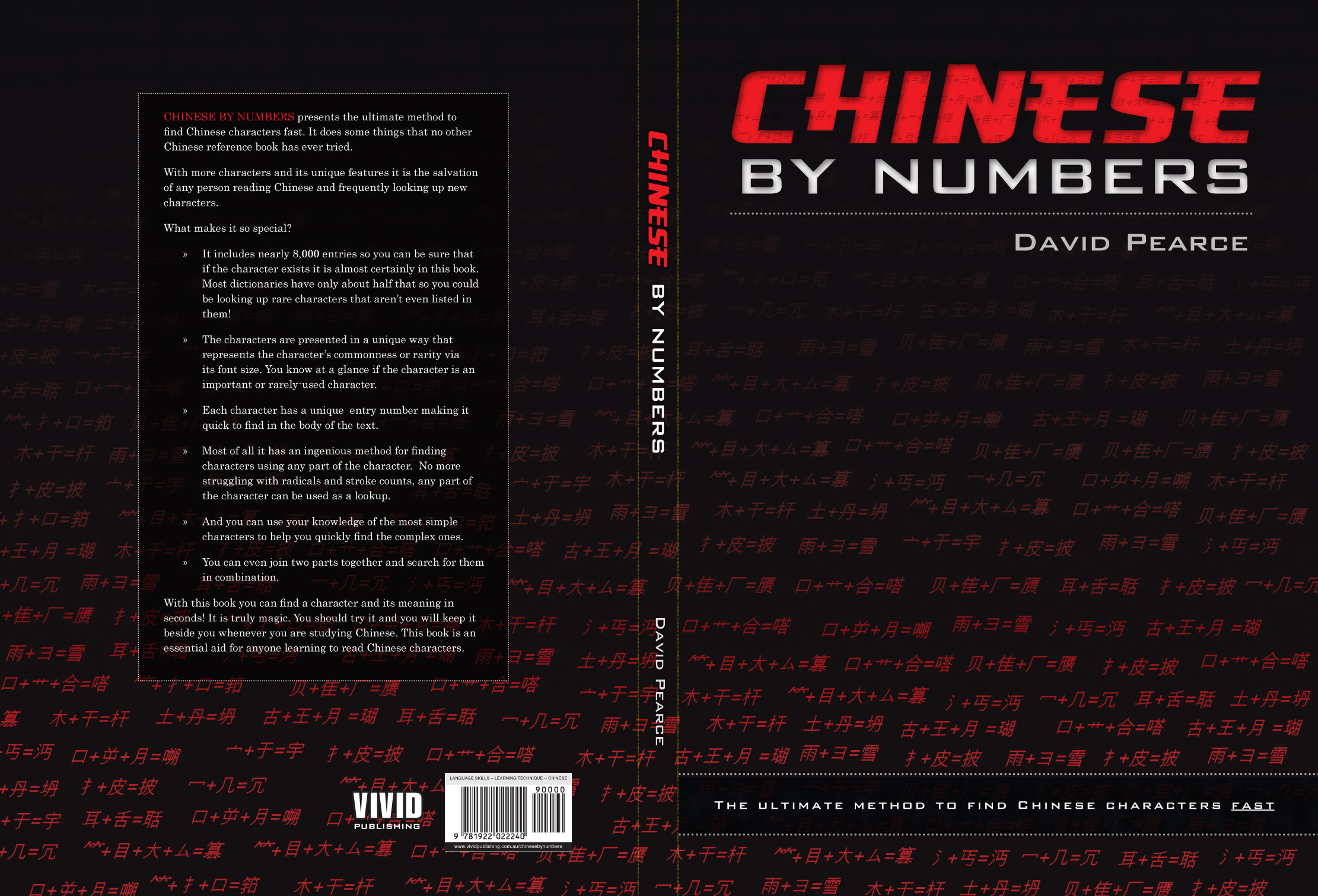
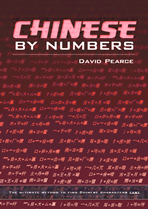
Chinese by Numbers Cover
Available only online

Character list shows character’s importance

Standard

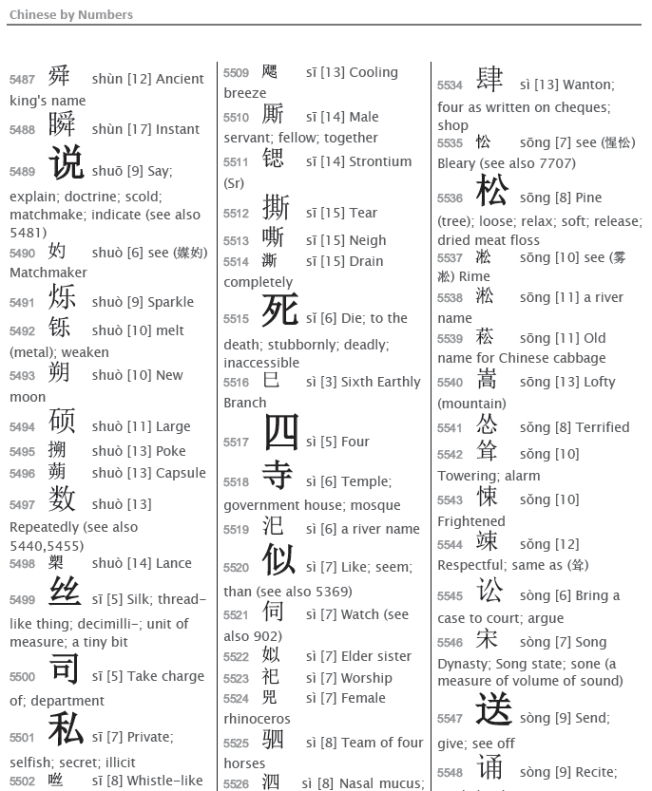
A unique feature of Chinese by Numbers is to illustrate the relative importance of each character via the font size. Knowing the importance of a character gives a reader several advantages including finding the character and secondly, knowing whether this character is one which deserves more study. With so many Chinese characters the reader has a way to discriminate and focus, while still seeing the broader context.

Here is an excerpt from a sample page:

The reader immediately knows which characters are important and which are trivial. The definitions are compact so it is possible to scan many characters at a glance on just one page. In addition, each entry is numbered. When an entry is found in the index it points the reader directly to the correct entry, rather than a page location or a pinyin reference. All of this makes for more efficient searching, reading and learning.

The book is available on Amazon, etc.

http://www.amazon.com/Chinese-Numbers-ultimate-method-characters/dp/1922022241

http://www.bookdepository.com/Chinese-by-Numbers-David-Pearce/9781922022240

http://www.barnesandnoble.com/w/chinese-by-numbers-david-j-pearce/1110603411?ean=9781922022240

http://www.vividpublishing.com.au/chinesebynumbers/


A book for Chinese Learners by a Learner of Chinese

Standard

Buy from Amazon

Chinese by Numbers is not an academic text. It was written by a student of Chinese to meet the needs of learners.

While I have been learning Chinese as a pastime of mine for the last 10 years, I often had these experiences:

  • Spending a lot of time looking up a new character
  • Then finding that the character is not listed in my regular dictionary
  • Knowing the approximate pinyin but wanting to quickly confirm the tone of a character
  • Wanting to confirm the exact form of a known character that I wanted to write
  • Wanting to know if the new character I just found was worth remembering

Most reference books don’t meet these needs:

  • Dictionaries all use the radical + stroke count method that can often be quite slow
  • Most dictionaries for students only have 3000 to 4000 characters. While the rest are not common, they come up often enough to be really frustrating
  • Dictionaries are quite useless for just reviewing the tone or exact form for a known character
  • Dictionaries give equal prominence to the least important characters

For me Chinese by Numbers as a reference book is the most important aid to carry.

  • Quick look up
  • All characters listed
  • Compact listing
  • Concise definitions
  • Prominent display of important characters

Read other pages on this site for more information,  or make an online purchase and see for yourself.

[NOTE: Chinese by Numbers is a ‘print on demand’ book. Each order is printed individually, specially for you, so the price is higher than other books sold to clear remainder stock.]

Available from Amazon and other online sites:

Barnes and Noble

Australian sales

UK sales

Chinese by Numbers Cover

Available only online

What makes Chinese by Numbers unique?

Standard

There are things that “Chinese by Numbers” does that no other book does.

  • It lists all the printable (simplified) Chinese characters in a complete, compact list
  • It shows the relative importance of each character through its font size
  • It assigns a unique number to each entry, for fast reference
  • It permits you to search for characters in three different ways
  • It permits you to search on every part of a character
  • It permits searches on the phonetic component of a character
  • It allows you to construct an unknown character by building from small to larger components
  • It lists all the characters sharing common phonetic components in groups
  • It allows searches on two components combined
  • It rewards your existing knowledge to short-cut your identification of new characters

So if you are looking up new characters, reviewing your vocabulary, checking meanings or checking tones you will value having this book with you whenever you are studying.

Available from:

http://www.amazon.com/Chinese-Numbers-ultimate-method-characters/dp/1922022241

http://www.bookdepository.com/Chinese-by-Numbers-David-Pearce/9781922022240

http://www.barnesandnoble.com/w/chinese-by-numbers-david-j-pearce/1110603411?ean=9781922022240

Australian sales:

http://www.vividpublishing.com.au/chinesebynumbers/

UK sales:
http://www.amazon.co.uk/Chinese-Numbers-ultimate-method-characters/dp/1922022241/ref=sr_1_1?ie=UTF8&qid=1336792167&sr=8-1

Who could benefit by having Chinese by Numbers?

Standard

Many readers would appreciate having this book
• The serious student of Chinese will be interested in having a near-complete list of all the simplified Chinese characters with concise definitions
• Any user would appreciate how the book vividly distinguishes the importance of each character via the font size
• Students reviewing vocabulary can easily pick out the characters that they should know
• Anyone reading Chinese will welcome the comprehensive and unique indexing system that reduces search time by about 60%
• They will be thrilled that their knowledge of basic characters gives them new strategies for finding characters quickly
• The advanced student can gain additional knowledge searching the phonetic patterns illuminated by the various indexes
• The beginner student can find any character just by piecing together parts of each character, even those with ‘difficult-to-classify’ radicals
• Even the non-student will like having a book that gives them a glimpse into the complexity and subtlety of the Chinese language

http://www.amazon.com/Chinese-Numbers-ultimate-method-characters/dp/1922022241

http://www.bookdepository.com/Chinese-by-Numbers-David-Pearce/9781922022240

http://www.barnesandnoble.com/w/chinese-by-numbers-david-j-pearce/1110603411?ean=9781922022240

http://www.vividpublishing.com.au/chinesebynumbers/

Sample search in Chinese by Numbers

Standard

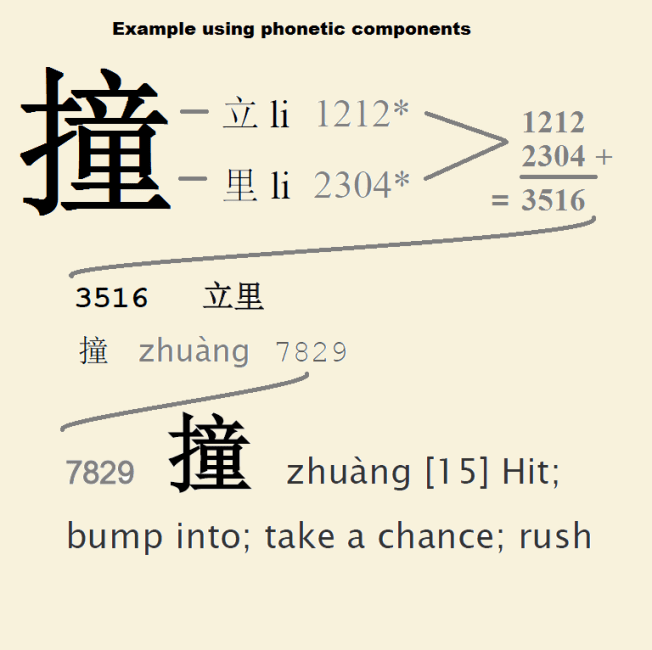
You may be looking for the character shown below (撞) which, although quite a common character, is not in my Oxford Concise Chinese-English dictionary.

Perhaps you are already familiar with the components that make up the right-hand side of the character, top and bottom. By coincidence they both share the pinyin (li). Chinese by Numbers has an index of the pinyin value of each component so finding this character is a cinch.

Rather than look up the 400 or more characters that share the same radical, in Chinese by Numbers you can easily look up the right-hand side, and by adding the two index numbers and using the dual component index your search gets the correct answer in seconds.

Using two components together

You see, the book allows readers to make the most of their existing knowledge of the basic characters to minimise the wasted time spent searching through the radical indexes of traditional dictionaries. This improves reading speed, comprehension and enjoyment. It also trains the eye of readers to see the whole character.

When you look at this example you can easily see why the book is called Chinese by Numbers!