Author Archives: davidjmspearce

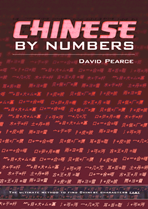
Who could benefit by having Chinese by Numbers?

Standard

Many readers would appreciate having this book
• The serious student of Chinese will be interested in having a near-complete list of all the simplified Chinese characters with concise definitions
• Any user would appreciate how the book vividly distinguishes the importance of each character via the font size
• Students reviewing vocabulary can easily pick out the characters that they should know
• Anyone reading Chinese will welcome the comprehensive and unique indexing system that reduces search time by about 60%
• They will be thrilled that their knowledge of basic characters gives them new strategies for finding characters quickly
• The advanced student can gain additional knowledge searching the phonetic patterns illuminated by the various indexes
• The beginner student can find any character just by piecing together parts of each character, even those with ‘difficult-to-classify’ radicals
• Even the non-student will like having a book that gives them a glimpse into the complexity and subtlety of the Chinese language

http://www.amazon.com/Chinese-Numbers-ultimate-method-characters/dp/1922022241

http://www.bookdepository.com/Chinese-by-Numbers-David-Pearce/9781922022240

http://www.barnesandnoble.com/w/chinese-by-numbers-david-j-pearce/1110603411?ean=9781922022240

http://www.vividpublishing.com.au/chinesebynumbers/

Find it fast and avoid frustration!

Standard

Find it fast and avoid frustration! That was the key theme in designing this book. Finding characters fast means more productive study. And frustration is an emotion shared by many who have used a Chinese Dictionary.

Finding characters fast? Try searching for the character,   It looks complex but contains two very common characters, mù anddà. Using this basic knowledge and this book to find this character takes about fifteen seconds! The same search in a Chinese dictionary took me over two minutes.

Frustration using Chinese dictionaries can be illustrated by trying to look up the character, 里 (lǐ). To look up a Chinese character in a typical Chinese dictionary you search on the ‘radical’, which is the component of a character that carries the sense or meaning (the other part of the character is usually called the ‘phonetic’ part, which conveys the sound.) Both 田and 土are radicals and里 looks like a combination of these two radicals, but if you look up either of these in a traditional radical index, you will never find里. That is because里 is itself a radical so you look it up under itself! That is frustrating, but say you look up a character that contains 里. There are many that contain里, but if you look for characters which have this radical (里) you may find only six of the thirty-one characters that actually contain里! That is because the other twenty-five characters contain里in the ‘phonetic’ component. Of course there is no way knowing that when you start your search!

My book indexes all parts of the character so that you can be sure to find any character, no matter what, even starting with just one small part of the character. What is more, my book permits you to search for combinations of components, which is something that no other book attempts!

I wanted to make a book that I would like to use and I believe that I have done so. I recall a few minutes after arriving home with a printed draft I was already using this book to search out new characters from a Chinese novel that I was reading. I suddenly felt a great sense of freedom. It was so quick!

I hope that many other readers find the same satisfaction using this book.

Sample search in Chinese by Numbers

Standard

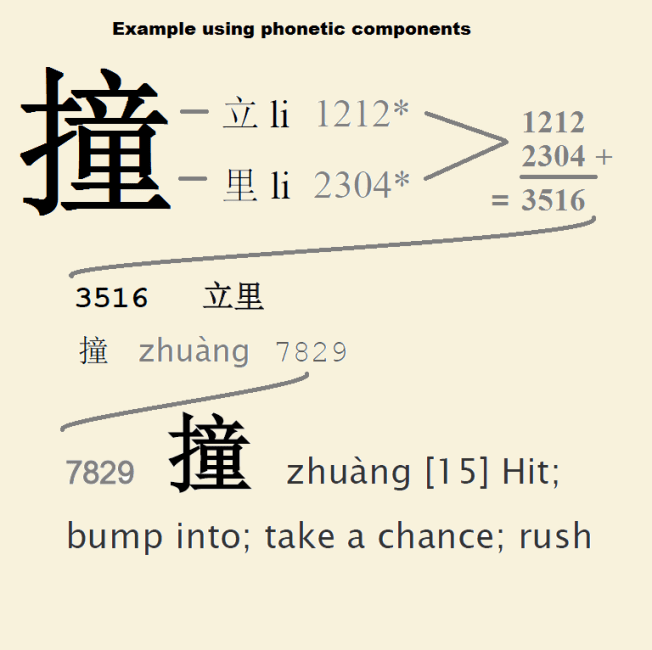
You may be looking for the character shown below (撞) which, although quite a common character, is not in my Oxford Concise Chinese-English dictionary.

Perhaps you are already familiar with the components that make up the right-hand side of the character, top and bottom. By coincidence they both share the pinyin (li). Chinese by Numbers has an index of the pinyin value of each component so finding this character is a cinch.

Rather than look up the 400 or more characters that share the same radical, in Chinese by Numbers you can easily look up the right-hand side, and by adding the two index numbers and using the dual component index your search gets the correct answer in seconds.

Using two components together

You see, the book allows readers to make the most of their existing knowledge of the basic characters to minimise the wasted time spent searching through the radical indexes of traditional dictionaries. This improves reading speed, comprehension and enjoyment. It also trains the eye of readers to see the whole character.

When you look at this example you can easily see why the book is called Chinese by Numbers!

Phonetic patterns revealed in the index

Standard

One of the incidental benefits of the indexing method of my book is how it gives users insight into the phonetic patterns of Chinese characters. 

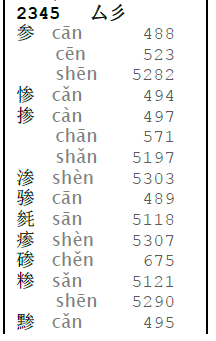
Consider this little extract from the dual component index:

Image

The sounds for these related characters are all very similar, but all a little different. Having seen this pattern helps readers to understand the range and variation of this phonetic pattern. The next time they see the same phonetic element they will have advance knowledge of what the likely pronunciation will be.

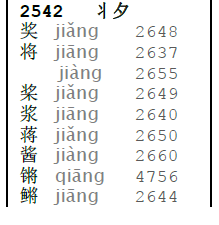
Here is a similar grouping:

Image

You can see the consistency in the pronunciation and the variation in tone of these related characters. I find this gives real insight into Chinese phonetics.

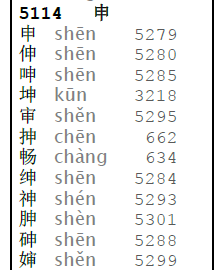
Finally, here is another grouping by the phonetic element:

Image

Again, you can see the consistency and the exceptions in the pronunciation of the phonetic element. 

There are, of course, hundreds of examples of this in the book, and only in this book.


The story behind Chinese by Numbers

Standard

When I started to learn Chinese in 2000 I soon realized that just learning the sounds was not enough. Nor could you just learn the pinyin and expect to make sense of the language. You need to learn characters.

Once I learnt a few characters I was hooked, but if I ever picked up an actual publication in Chinese I was stuck. Each line had one or two new characters. In my small dictionary I searched for the characters, and each search took at least a minute and sometimes much more. Reading was getting easier but looking up characters was a limiting factor. I found many problems:

  • Identifying the radical (sometimes obvious, but not always.)
  • Looking through the long lists when the radical was very common (four hundred characters have 扌as their radical)
  • Looking for characters with ‘hard-to-classify’ radicals
  • Trying to find a character that was not even in my usual dictionary (How do you find something when it isn’t there!)
  • Using a bigger dictionary meant more characters but then searches became slower, looking through 2600 pages!

What was frustrating was I couldn’t effectively use my acquired knowledge. I might recognize the ‘phonetic’ part of the character but I couldn’t search for that.

In 2010 I started working on a better way to find characters. I made a list of almost all the characters that can be written using a Windows-based computer and I broke them down into their components. Each component was given an index number. I made it so that you could add the index numbers together to search for a combination of two components. My theory was that as characters are normally comprised of combinations of components then it would be possible to break each character down to its components and then have an index that put the characters back together. Searching on any component or combination of components would make for much quicker and more reliable searches. For example, if you saw a character with a 廿 in it, you could look it up in this book but not in a normal dictionary. All those characters are listed together in Chinese by Numbers. There is no dictionary or mobile app that can do that. Suppose you are interested to know the variation in pronunciation of characters that contain and. This book gives a list and you quickly find that most are pronounced either láo or yíng. You can’t get that from any dictionary or app.

Then, in the body of the book, I identified which characters were most important and which were comparatively rare. Each entry shows this in the font size. A big font means an important character. This makes it very easy to use the book for study, concentrating on the most important characters. As I use this book I keep finding new useful features .

Once I had a printed draft of my book I quickly realized how good it was to have a reliable quick and thorough way to search for new characters. So I decided to publish and in the end chose self-publishing. I have had a great response from those who have used it, but reaching my market is difficult. I hope that if you are reading this and want to get a copy that you might use the links below:

Buy from Amazon

http://www.amazon.com/Chinese-Numbers-ultimate-method-characters/dp/1922022241

http://www.bookdepository.com/Chinese-by-Numbers-David-Pearce/9781922022240

http://www.barnesandnoble.com/w/chinese-by-numbers-david-j-pearce/1110603411?ean=9781922022240

http://www.vividpublishing.com.au/chinesebynumbers/

Hello world!

Standard

Thank you for visiting Chinesebynumbers.com.

This site is to introduce you to a really cool new book for those learning Chinese.

Did you know that even if you know 2000 Chinese characters you might spend half or more of your reading time just looking up new characters? Chances are it is even higher. So anything that can help you find characters faster has got to be good.

My book reduces minutes to seconds when finding difficult characters.

Chinese by Numbers

The Ultimate Method to Find Chinese Characters FAST