You may be looking for the character shown below (撞) which, although quite a common character, is not in my Oxford Concise Chinese-English dictionary.
Perhaps you are already familiar with the components that make up the right-hand side of the character, top and bottom. By coincidence they both share the pinyin (li). Chinese by Numbers has an index of the pinyin value of each component so finding this character is a cinch.
Rather than look up the 400 or more characters that share the same radical, in Chinese by Numbers you can easily look up the right-hand side, and by adding the two index numbers and using the dual component index your search gets the correct answer in seconds.
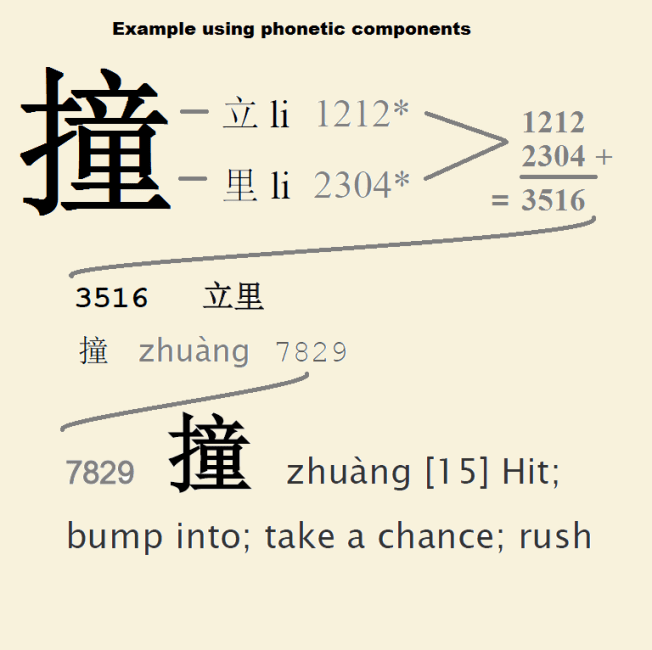
You see, the book allows readers to make the most of their existing knowledge of the basic characters to minimise the wasted time spent searching through the radical indexes of traditional dictionaries. This improves reading speed, comprehension and enjoyment. It also trains the eye of readers to see the whole character.
When you look at this example you can easily see why the book is called Chinese by Numbers!
 Chinese by Numbers